
Golden-crowned and Ruby-crowned Kinglets (Regulus satrapa and Regulus calendula)
Prepared by Paul Nicholson, March 2025


Although both kinglets are very similar, the Golden-crowned Kinglet (left) has a distinctive striped crown, while the the Ruby-crowned Kinglet has bold wingbars (right). Photos by Paul Nicholson
Londoners are fortunate to have opportunities to see both of the North American kinglet species every year. Since the Golden-crowned Kinglet and the Ruby-crowned Kinglet are so similar, it makes good sense to the consider these delightful “little kings” together for easy comparison.
The seasonal distribution of both of these species is similar. Numbers of both species peak in April and May, and again between late September and early November.
The size of the kinglets is very similar. At 9 or 10 cm in length, both of these petite birds are smaller than chickadees and warblers.
The overall plumage of both birds is mostly a drab, dull olive green.
Golden-crowned Kinglets prefer coniferous habitats, but both species can be seen in a broad range of habitats.
Finally, the behaviors of both bird species are similar. Both may be found in mixed flocks. Both species feed primarily on insects. Additionally, these birds are both extremely active perpetual motion machines. This behavior aids in finding insects on foliage.
With so much in common, how can bird enthusiasts tell the birds apart? A few field marks, different vocalizations, and a few other aspects of the birds’ lives make that task very doable.
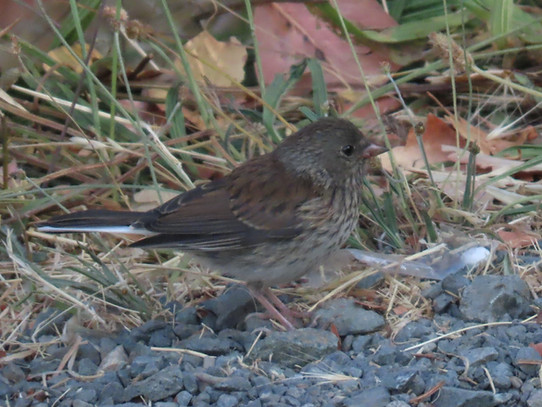
A juvenile Dark-eyed Junco already has distinctive white flashes on the sides of its tail. Although they initially have streaked plumage on the chest and flanks, the streaking fades as the young birds mature.
The Golden-crowned Kinglet is a well-named bird. Two obvious black stripes on the bird’s crown frame a yellow or sometimes orange stripe. It is this field mark that gives the bird its Latin scientific name. Regulus satrapa translates to "little king ruler."
The Golden-crowned Kinglet also has a black eye line and a brighter light stripe above that.
While the two birds’ seasonal distribution is similar with peaks during the spring and fall, it is possible to occasionally see a Golden-crowned Kinglet in Middlesex County through the summer months. A few breeding pairs stick around Southwestern Ontario. This species usually nests high up in coniferous trees. Some Golden-crowneds will also linger into or even through the winter.
A typical Golden-crowned Kinglet song is series of high-pitched tsee-tsee-tsee-tsee notes. These birds are most vocal in the spring.
Listen to the Golden-crowned Kinglet’s high-pitched call below:
Finding the species in London:
In London and elsewhere in Middlesex County, Dark-eyed Juncos are usually easy to find in the winter months. One location that is often reliable is at the Fanshawe Conservation Area in north-east London. Check out the Tamarack Trail trailhead immediately south of the parking lot near the dam.
Click here to learn more about the Golden-crowned Kinglet’s life history.
Help make London more Junco friendly:
Although Dark-eyed Junco populations are stable, there are several ways to help keep them safe and welcome in our communities.
-
Keep pet cats indoors or contained while outside to prevent them from predating birds.
-
Avoid use of pesticides and reduce your ecological footprint as much as possible.
-
Retrofit your home windows using bird-friendly materials to prevent window collisions.
-
Support the protection of natural habitats that Dark-eyed Juncos need for food, shelter and breeding.
-
Grow native plants in your yard and leave plants alone during the winter until the risk of frost has passed in the spring (late April-early May in London)
-
If you use bird feeders, keep them clean.
-
Participate in citizen science initiatives such as recording Junco sightings and other bird sightings in eBird and iNaturalist